Biography
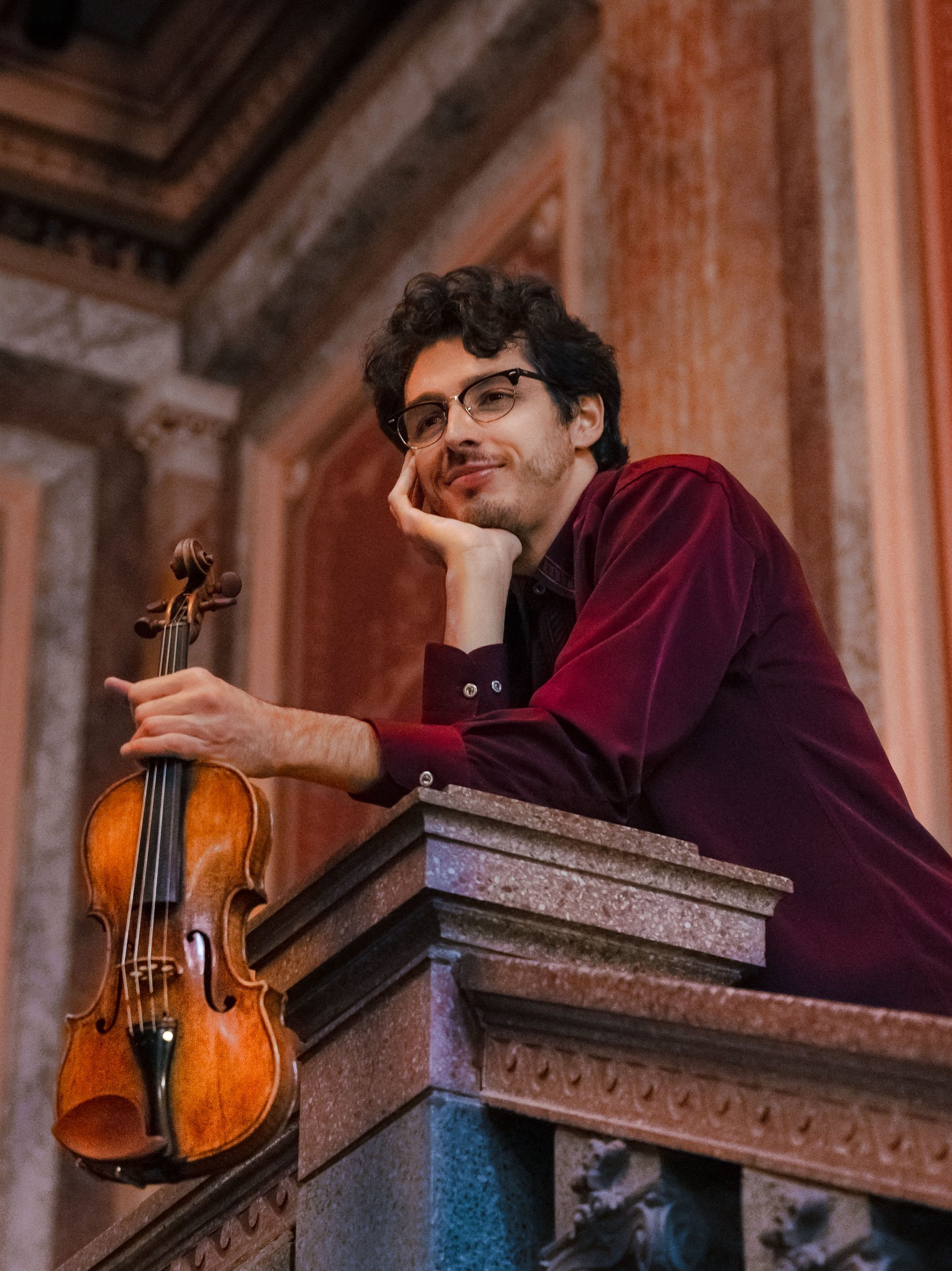
Mathieu Garguillo stands out as one of the most versatile violinists of his generation. Equally adept in both modern and baroque violin, he integrates the two in search of a deeper understanding of the music.
A vivid and sought-after chamber musician, Mathieu has shared the stage with acclaimed artists such as Stefan Dohr, Kari Kriikku, Kirill Kozlovski, Petteri Iivonen, Eriikka Maalismaa, Jonathan Roozeman, Jakub Jakowicz among others.
Highly regarded for the clarity, energy, and collaborative spirit he brings to an ensemble, Mathieu is regularly invited both as a guest concertmaster and as a guest leader of the second violins. His experience includes guest concertmaster appearances with the Kuopio Symphony Orchestra, and guest leadership of the second violins in the Tapiola Sinfonietta, Lapland Chamber Orchestra, Sinfonia Lahti and the Oulu Symphony Orchestra.
One of Mathieu’s most meaningful musical collaborations has been with pianist Paavali Jumppanen. Together they have worked on and performed major repertoire for violin and piano, including the complete Beethoven and Brahms sonatas, as well as works by Schubert, Szymanowski, Fauré, Janáček and Mozart.
Mathieu is also a founding member of the Guts! Quartet, alongside Irma Niskanen (violin), Hanna Pakkala (viola) and Juuli Holma (cello). Their repertoire spans from the intricate polyphony of the Renaissance to the expressive string quartets of the 19th century and beyond — always performed on period instruments and informed by historical awareness.
Born in Toulouse, Mathieu’s musical journey began at the conservatory in his home town before taking him to Paris to study with Christophe Poiget. He holds a Master of Music degree from the Sibelius Academy in Helsinki as a student of Mari Tampere-Bezrodny. After his graduation, Mathieu has continued to deepen his knowledge in historical performance under the guidance of Kreeta-Maria Kentala.
Other important mentors for him include Chaim Taub, Jean-Jacques Kantorow and Paavo Pohjola.
Mathieu plays on a violin by Andrea Stanzer made in Genoa in 1722.
My craftsmanship
Every piece of music I play — from the 17th century to the 21st — goes through the same essential process.
I begin by trying to understand the world in which it was written: the language of its composer, the aesthetic ideals of the time, and the architecture hidden within the score. Only then does the true shape of the composition start to reveal itself.
This phase of my work, when I am alone with the music, is deeply intimate. It is the moment when my intellect and heart meet. Connecting the two is immensely important. I often feel like an archaeologist, digging patiently and carefully to uncover whatever treasures lie beneath the surface. The process is always mysterious; sometimes clarity arrives only during the concert itself. In fact, a piece never fully opens to me until I perform it live.
Love and playfulness guide me, and I feel musically free only when the music begins to give the illusion of improvisation. On stage, I can forget myself, allowing the music, the performer, and the audience to become a single entity.
 Mathieu Garguillo